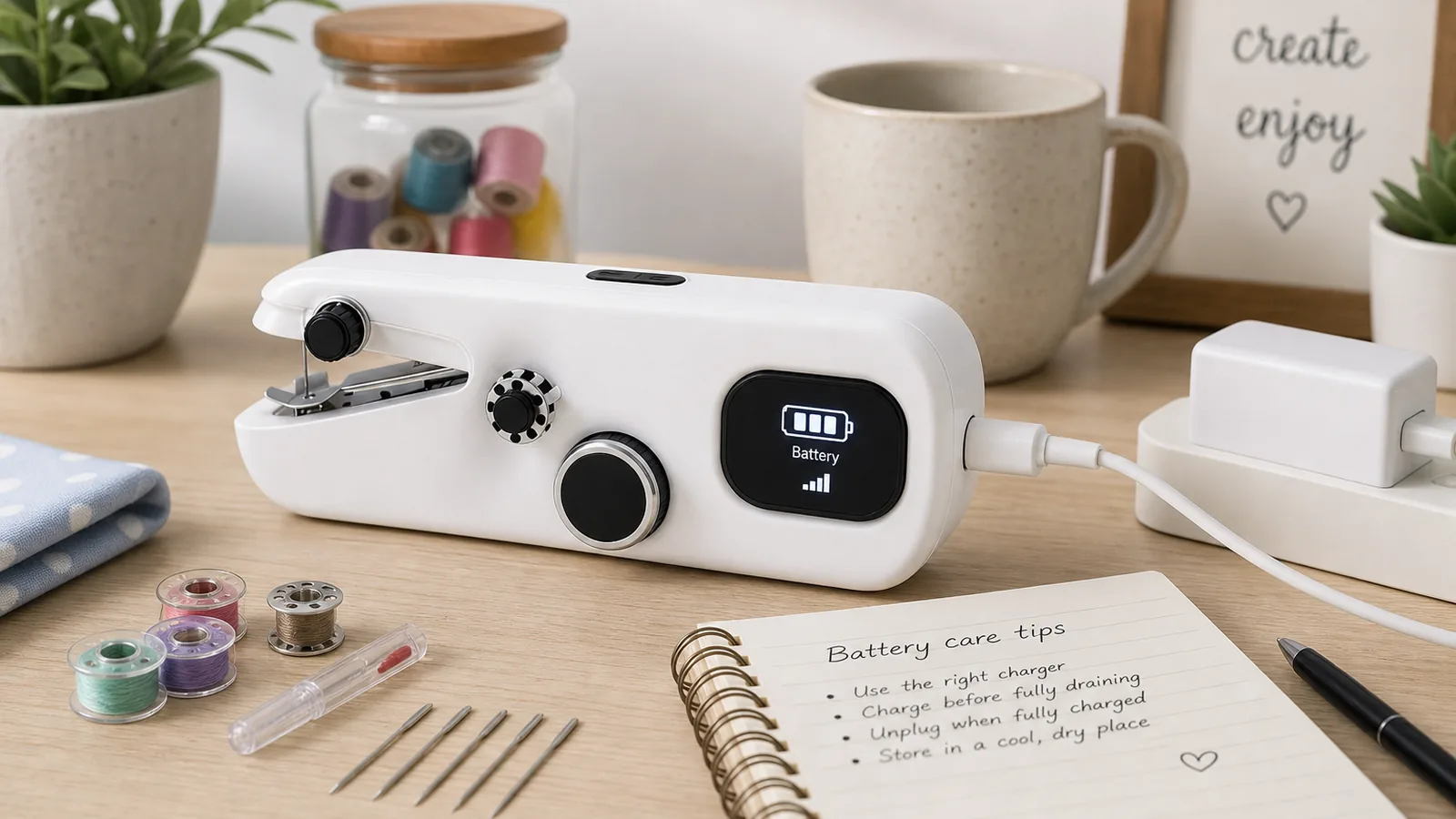
battery care tips cordless sewing machine UK
For battery care tips cordless sewing machine UK owners can rely on, treat charging as a short ownership checklist: fully charge before the first session, watch for weak-feed signs mid-hem, store with a sensible residual charge, avoid guessing runtime figures, and stop to recharge as soon as stitches feel uneven—then review the current product details for your model’s charging notes.
Charge before first use
Before you sew for the first time, give a USB rechargeable cordless handheld unit a complete charge following the maker’s lead and cable guidance. Fresh charge habits matter more than guessing how long to charge cordless handheld sewing machine batteries in minutes: if the listing or leaflet gives a first-charge step, follow that; otherwise charge until the indicator shows ready, then begin a small practice seam on scrap fabric.
USB rechargeable sewing machine charging tips UK buyers should keep in mind include using the supplied lead where possible, keeping the port free of lint, and charging on a dry, stable surface away from damp worktops.
Signs of low battery during a hem
When battery weak stitches skip UK menders often notice the machine slowing, hesitating, or forming uneven loops before it stops altogether. Other everyday clues include a fading charge light, a motor that sounds strained on light fabric, or a hem that no longer advances smoothly under light hand guidance.
If stitches start to skip or bunch during a hem, pause rather than forcing the seam. Reposition the fabric, check the thread path, then recharge if power still feels soft—especially on a beginner-focused rechargeable handheld tool used for DIY mending rather than continuous workshop runs.
Storage charge habits
For short gaps between projects, store the machine clean, cool, and dry with a partial charge rather than leaving it fully empty for weeks. For longer storage, top up occasionally so the pack does not sit drained, and avoid leaving it on charge indefinitely once full if your indicator shows completion.
Keep the USB port covered from dust when idle. Compact handheld machines sold for on-the-spot repairs are built to be portable, so treat the battery like any other small rechargeable household tool: charge before a planned mend, then store safely out of direct heat.
Use confirmed details runtime numbers
Do not rely on overheard “hours per charge” figures, forum guesses, or marketing snippets that are not on your own packaging or product page. Runtime varies with fabric weight, stitch speed setting, and how hard you feed the work—so treat any third-party minute count as unverified.
Use the charge indicator and stitch quality as your guide instead of calendars or stopwatches. If a seller only describes the machine as compact, lightweight, or suitable for quick repairs, that still does not prove a fixed runtime.
When to stop and recharge
Stop and recharge as soon as feed feels weak, stitch formation becomes irregular, or the unit powers down mid-seam. Finish the current few centimetres only if the stitch remains secure; otherwise mark the point, unplug or switch off as instructed, and charge fully before continuing.
Repeated brown-outs mid-hem waste thread and risk an uneven finish. A soft recharge pause is quicker than unpicking a skipped line later.
Next step
For model-specific charging notes, LCD cues, and speed-setting guidance on this rechargeable beginner handheld option, see the current product details before your next mend.
FAQ
How long should I charge a cordless handheld sewing machine?
Follow the charge time or indicator steps in your own manual or listing. If none are stated, charge until ready rather than inventing a minute count from other brands.
What are practical USB rechargeable sewing machine charging tips in the UK?
Use the supplied lead where available, charge on a dry surface, keep the port clear of fluff, and disconnect once the ready signal appears unless the maker says otherwise.
What should I do when a weak battery makes stitches skip?
Pause the hem, secure the thread, recharge fully, then resume on scrap fabric to confirm even feed before returning to the garment.
Are handheld cordless machines meant for heavy production sewing?
No. Treat them as portable helpers for light DIY mending and on-the-spot repairs, not as industrial lockstitch or production machines.