Handheld sewing machine not sewing troubleshooting UK
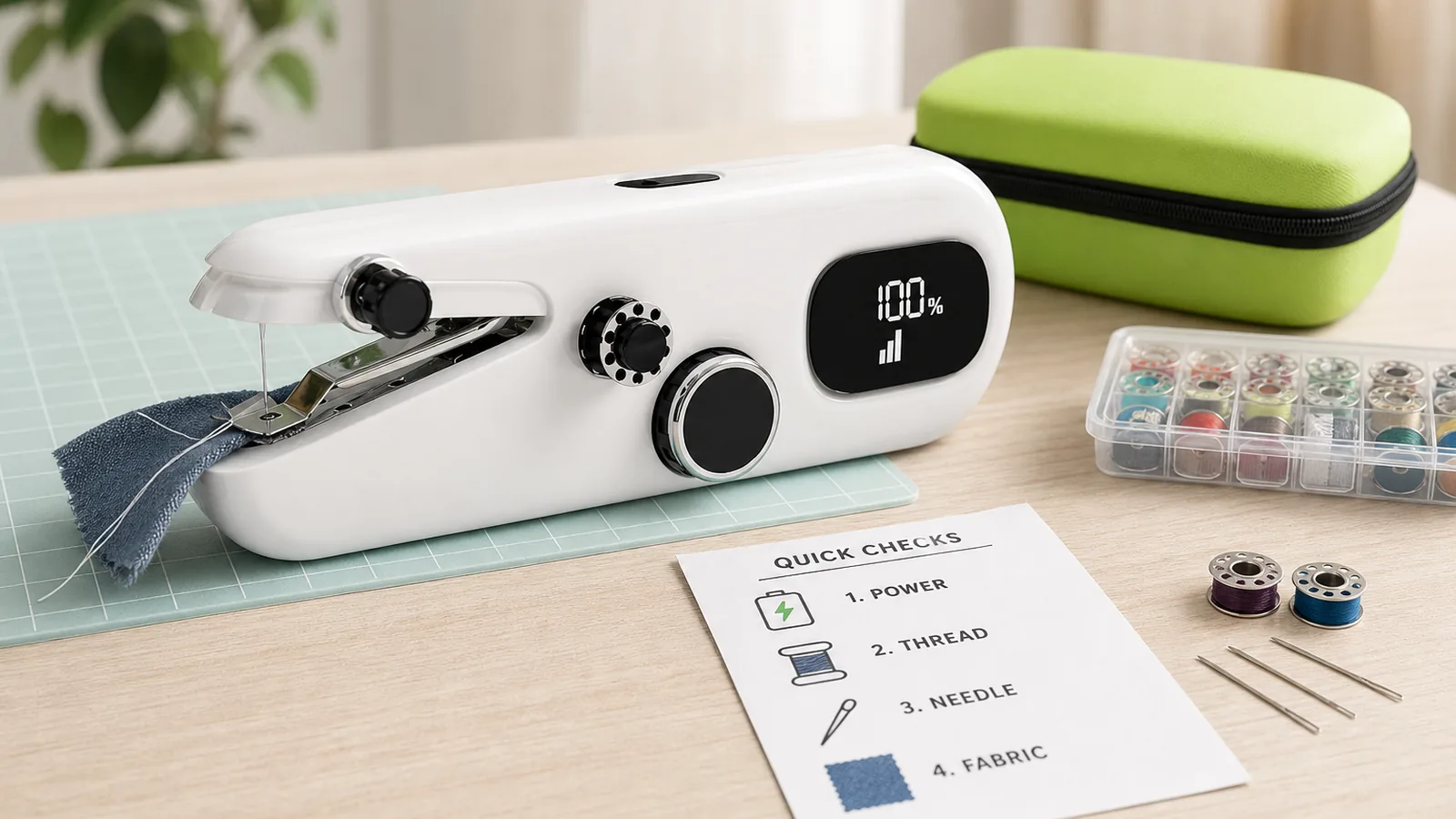
For handheld sewing machine not sewing troubleshooting UK, work in this order: confirm the unit has enough charge or power, rethread carefully, check needle orientation and condition, then stop if the fabric is too thick or unsuitable—before assuming the machine is faulty.
Direct answer: check charge, threading, needle orientation, fabric thickness
Most “not sewing” faults on a mini or portable handheld unit come from simple setup issues rather than a broken motor. If stitches skip, the thread keeps breaking, or the machine jams, pause and run the four checks below before changing settings or fabric.
- Charge or power — a weak battery or loose connection often means the needle moves weakly or not at all.
- Threading — a missed guide or loose upper thread is a common reason for skipped stitches and breakages.
- Needle orientation — a needle fitted the wrong way, bent, or blunt will refuse to form a stitch.
- Fabric thickness — dense seams, multiple layers, or stiff material can stall a compact handheld tool meant for light mending.
Power and charge checks
Before you blame the mechanism, confirm the machine can run steadily. Switch it on and listen for a consistent drive sound rather than intermittent hesitation.
- Ensure any rechargeable handheld is charged enough for a short test sew on scrap cloth.
- If your model can run from a plug-in supply as well as a battery, try the power method your manual supports and seat the connector firmly.
- Release any safety lock or switch that prevents the needle from cycling.
- Hold the fabric lightly; forcing thick material while power is low often looks like a jam.
Keep battery and USB behaviour general: follow the care notes that came with your unit, and avoid running it until it cuts out mid-stitch.
Rethread ladder
Incorrect threading is behind many “portable sewing machine thread keeps breaking UK” complaints and skipped-stitch reports. Unthread completely, then rebuild the path from spool to needle.
- Raise or free the needle so you can see every thread guide.
- Seat the spool so it feeds smoothly without snagging.
- Pass the thread through each guide in the order shown on your machine or booklet—do not skip tension discs or slots.
- Thread the needle eye in the direction your design requires, leaving a short tail.
- Hold both fabric and thread tails for the first few stitches on a scrap.
If the thread still snaps, check for a nick on a metal guide, an over-tight tension path, or a spool that jerks as it turns. For a mini sewing machine skipped stitches fix UK approach, rethreading is usually more effective than forcing thicker thread.
Needle change
A bent, blunt, or wrongly seated needle will not pick up the thread correctly and can cause jams.
- Power off before you change the needle.
- Note the flat or marked side so the replacement faces the same way as the original.
- Tighten the clamp firmly so the needle cannot drift while sewing.
- Replace needles that look bent, burred, or that hit the plate with a click.
After fitting a new needle, rethread and test on scrap. Do not continue if the needle strikes metal—that is a stop condition, not a “push harder” moment.
Fabric suitability stop rules
Handheld tools are typically sold for light, on-the-spot repairs and portable DIY mending, not for heavy production sewing. Compact examples on the UK market are presented as lightweight machines for quick fixes rather than workshop lockstitch replacements.
Stop and change approach if you see any of the following:
- The handwheel or drive struggles, stalls, or the fabric will not advance.
- You are stacking many layers, thick denim seams, or stiff upholstery-weight cloth.
- The needle heats, bends, or leaves large holes without forming a stitch.
- Thread loops into a bird’s nest or the machine jams repeatedly after correct threading—common reasons why handheld sewing machine jams UK users report mid-repair.
These units are not industrial lockstitch machines. If the job needs a full-size machine or hand stitching, switch method rather than forcing the handheld through unsuitable fabric.
Next step only after basics
Once charge, threading, needle, and fabric checks are clear, you can compare a beginner-focused rechargeable handheld option for home crafting and light mending. See the current product details for the portable handheld stitch unit if you need a simple reference point after the basics are sorted—treat any listed price as a dated projection only.
FAQ
Why does my handheld sew for a moment then stop?
Often the charge is low, the fabric is too thick, or a thread tangle has started under the plate. Clear the path, rethread, and test on thinner scrap before returning to the garment.
What should I try first for skipped stitches?
Rethread fully, confirm needle direction, and sew slowly on scrap. Skipped stitches usually improve after the thread path and needle are corrected.
When should I stop troubleshooting and change method?
Stop if the needle hits the machine, the drive stalls on thick seams, or jams return after a clean rethread and needle change. Move to a suitable machine or hand finish rather than forcing the repair.